Slab Leak Detection & Repair in Orlando, FL
Orlando's growth boom left behind thousands of homes with copper water lines poured directly into their concrete slabs — and decades later, those lines are starting to fail. From Winter Park and College Park to Lake Nona and Dr. Phillips, Slab Leak Detection Pros serves the greater Orlando area with same-day slab leak detection that finds the exact break without tearing up your home. Because Central Florida homes are built slab-on-grade with no basement, a leaking pipe hides in the concrete: the first symptoms are often just a climbing water bill or a mysterious warm spot on the tile. Our technicians combine pressure testing, acoustic listening, and thermal imaging to pinpoint leaks within inches, and we document everything with photos for your plumber or your insurance company. If you hear water running when every faucet is off, or your Orlando utility bill suddenly jumped, don't guess and don't dig — call (877) 762-1902 for non-invasive detection that gets you an answer the same day.
Neighborhoods We Serve in Orlando
Winter Park, Lake Nona, Dr. Phillips, Windermere, Baldwin Park, College Park, Thornton Park, Conway, Pine Hills, Metrowest — and every ZIP code in between.
Why Orlando Homes Get Slab Leaks
Orlando sits on deep sand over limestone, with a water table that often rests just a few feet below the surface — and in low-lying areas near the region's many lakes, even shallower. That saturated sand keeps slab foundations in near-constant dampness and exposes buried copper to corrosive soil chemistry, while Central Florida's intense wet-dry seasonal cycles make the ground swell and shrink around the slab. Homes in Conway, Pine Hills, and Metrowest built on graded fill see the most movement, and that micro-shifting fatigues rigid copper joints over decades.
Why Orlando Homes Get Slab Leaks
Orlando's slab leaks trace back to a simple fact of construction history. From the 1960s through the late 1980s, copper supply lines were the standard, and Central Florida builders routinely ran them through the concrete slab — cheaper and faster than routing through walls, and perfectly reasonable at the time. Fast-forward forty to sixty years, and those copper lines are now at the end of their practical life in Florida conditions. Orlando's water supply is notably hard and mineral-laden, and over decades that chemistry pits the inside of copper pipe, a failure mode plumbers call pitting corrosion. It starts as tiny dark spots and eventually becomes pinholes. From the outside, the story is no better: Orlando's sandy soil sits over a shallow water table, so pipes in the slab live in near-constant dampness, and the soil's natural minerals plus fertilizer runoff create an environment that attacks copper externally. Add Central Florida's weather pattern — intense summer downpours that saturate the ground, followed by dry spells — and the soil around the slab expands and contracts in cycles, shifting the foundation in microscopic increments. Rigid copper doesn't flex; it fatigues. And the region's explosive growth means countless Orlando homes in Conway, Pine Hills, and Metrowest sit on graded fill where the ground settles unevenly, stressing joints. Homes built from the mid-1990s onward generally have PEX or properly sleeved copper and rarely develop slab leaks — but if your home predates about 1990 and still runs its original lines, you're living on borrowed time.
Signs of a Slab Leak in Orlando Homes
In Orlando, the leak is almost never visible — tile and concrete hide it — so you learn to read the indirect signs. The most common is the water bill. OUC or Orange County Utilities bills that climb month over month with no change in your household are the number-one tip-off; a moderate slab leak can waste thousands of gallons monthly, and the bill is often the first thing that notices. The second signature symptom is a warm spot on the floor. Hot-water lines run through the slab too, and when one leaks, the escaping water heats the surrounding concrete. Walk barefoot across the tile in your Baldwin Park townhome or your Conway ranch — if one patch is noticeably warmer than the rest, that's diagnostic. Third, listen: with the house quiet, put your ear to the floor. Hissing or the sound of running water when everything is off is a strong indicator. Fourth, watch for moisture where it shouldn't be: damp carpet edges, baseboards that are swelling or growing mold, a musty smell in a specific room, or grout that stays dark and wet. Fifth, check the meter — turn off every fixture and irrigation zone, then watch the dial for ten minutes. Movement means water is leaving the system somewhere. In Dr. Phillips and Windermere, where many homes have pools, there's one extra check: make sure the pool's auto-fill isn't the culprit before assuming a slab leak. If the meter moves and the pool is innocent, you need professional detection, not a plumber with a jackhammer.
Slab Leak Repair Options in Orlando
Once we find the leak, Orlando homeowners generally choose between three repair approaches, and the honest answer depends on your plumbing's age and history. The first option is a spot repair: we cut a small, precise opening in the slab at the marked location — usually about two feet square — remove the failed section of pipe, and splice in new pipe. For a first leak in a 2000s-era home in Lake Nona with PEX or young copper, this is almost always the right call: minimal cost, minimal disruption, and the rest of the system is healthy. The second option is a reroute: new PEX water lines run through the attic and down interior walls, abandoning the under-slab pipes entirely. This is the workhorse solution for Orlando's 1960s-80s ranches in College Park, Thornton Park, and Pine Hills with original copper and a history of leaks — it costs more than a spot repair, but it permanently ends the cycle of slab openings and emergency water bills. Orlando's single-story homes with accessible attics make reroutes straightforward. The third option applies to drain-side leaks: epoxy lining or sectional point repairs for deteriorating cast-iron drains under the slab, common in mid-century Winter Park and College Park homes. What we won't do is guess. Orlando's 1970s-80s construction sometimes uses post-tension slabs, and cutting a tension cable while hunting blind for a leak can compromise the foundation itself. Every repair starts with a confirmed location and a flat, written quote — pipe fix, concrete patch, and flooring restoration spelled out separately so you know exactly what's included.
What Slab Leak Detection & Repair Costs in Orlando
Detection is the affordable part of the equation. In the Orlando market, a full professional slab leak detection visit — pressure test, acoustic listening, thermal imaging, and a written report — typically runs $140 to $400. Single-family homes in neighborhoods like Conway or Metrowest usually land in the middle of that range; larger homes in Lake Nona or Windermere with guest houses, pool lines, or multiple water heaters can push toward the upper end because every branch has to be tested. Repairs are where the numbers spread out. A straightforward spot repair under the slab in Orlando typically costs $2,000 to $6,500, depending on the pipe's depth, whether it's a hot or cold line, and how much tile or flooring must be restored over the patch. A full hot-and-cold PEX reroute through the attic — the popular choice for aging copper systems — usually runs $3,500 to $9,000 for a typical single-story Orlando home, with two-story homes and complex layouts costing more. Drain-side work under the slab is the widest variable: $3,000 to $12,000 or more depending on the length of failing pipe and access. Two things Orlando homeowners consistently underestimate: first, the water waste — a leak of even a gallon or two a minute can add thousands of gallons to your monthly bill, so delay is expensive; second, mold — in Central Florida's humidity, sustained moisture behind baseboards can start growing within two days. We quote every repair flat and in writing before anyone lifts a tool, and our detection reports are formatted to support insurance claims where coverage applies.
How We Detect Slab Leaks in Orlando
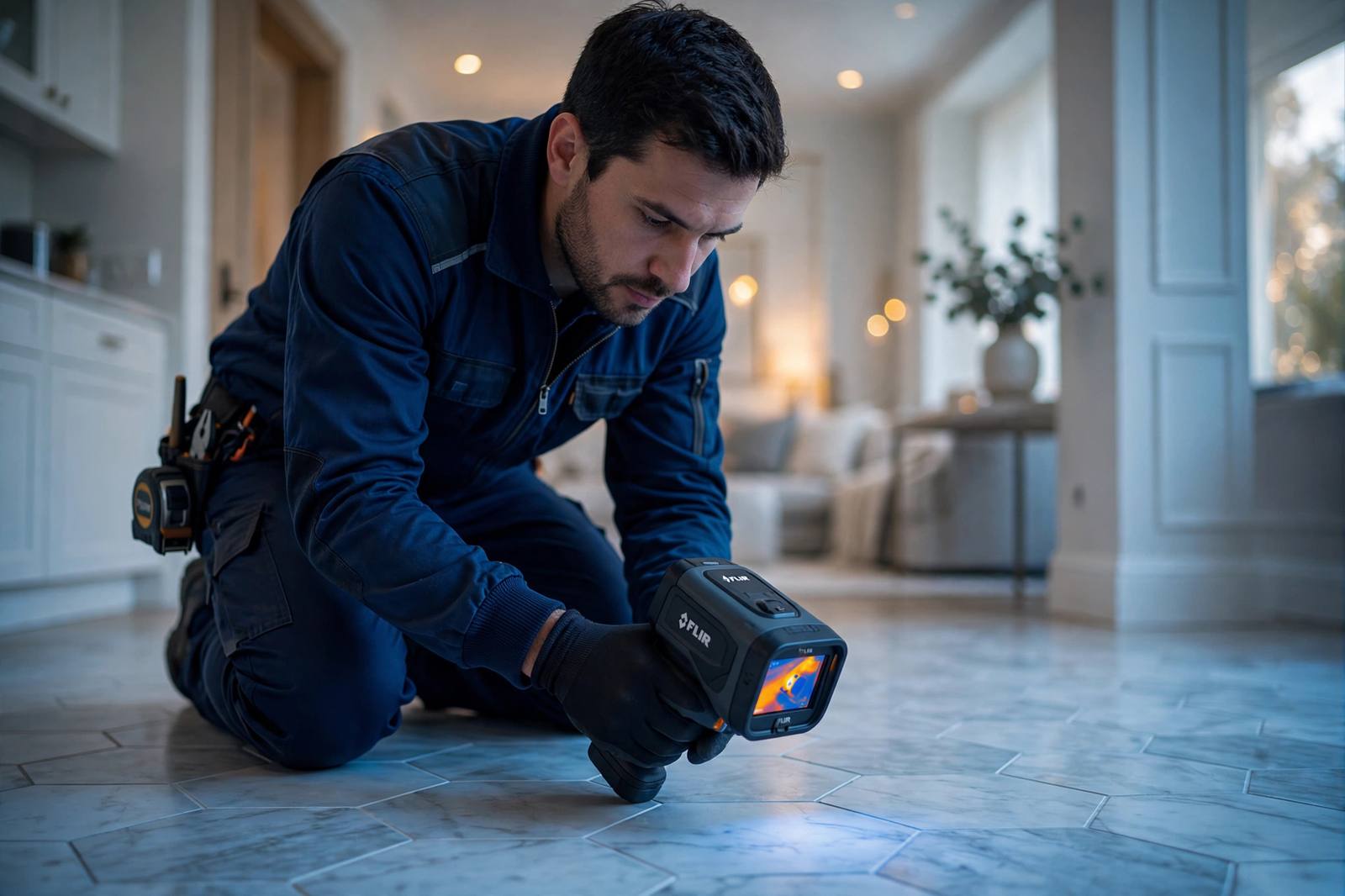
Our Orlando process is built around one rule: locate first, open nothing until we're certain. We start with a static pressure test, isolating the hot and cold systems to determine which side is losing pressure and how fast. That single test tells us whether we're hunting a supply leak or a drain problem, and it rules out roughly half the plumbing in one step. Next, acoustic detection: with the house as quiet as we can get it, our technician sweeps the slab with a ground microphone that amplifies the high-frequency hiss of water escaping a pressurized pipe. In Orlando's typically quiet suburban homes — Baldwin Park, Winter Park, the residential streets of Conway — this is remarkably precise; we're listening for a sound signature that's distinct from normal pipe noise, and experience matters. Then thermal imaging: an infrared camera reads the slab's surface temperature, and a hot-water leak appears as a warm bloom spreading outward from the break. This is especially effective in Orlando's tile-heavy homes, where tile conducts heat well. For cold-water or drain leaks that don't show heat, we use tracer gas — a safe, inert hydrogen-nitrogen blend introduced into the line that escapes at the break and percolates up through the concrete, where a sensitive detector sniffs it out. Finally, accessible drain lines get a camera inspection to confirm or rule out sewer-side failure. Most Orlando visits finish in one to two hours. You get a marked location on the floor, dated photos, and a written report — everything a repair plumber or an insurance adjuster needs, with zero demolition involved.
What to Do When You Suspect a Slab Leak
Suspect a slab leak in your Orlando home? Here's the order of operations that protects your floors and your money. Step one: verify. Shut off every faucet, toilet fill, washing machine, and irrigation zone, then check your water meter — the small dial or triangle should be perfectly still. If it moves over ten to fifteen minutes, water is escaping somewhere. Step two: rule out the easy stuff. A running toilet or a stuck pool auto-fill in Dr. Phillips or Windermere can mimic a slab leak's water-bill symptoms; confirm those are fine before assuming the worst. Step three: document. Photograph the meter reading, any damp baseboards, warm floor spots, or musty areas, with dates. If you end up filing an insurance claim, this timeline matters. Step four: don't dig. Resist the urge to have someone start breaking concrete on a guess — in Central Florida's older slabs, blind excavation destroys expensive tile over a leak that may be rooms away, and in post-tension slabs it can damage structural cables. Step five: call for detection at (877) 762-1902. We'll locate the leak acoustically and thermally, usually the same day, and hand you a marked spot and a written report. Step six: get the repair quoted flat and in writing, with concrete patching and flooring restoration itemized separately. And move with reasonable urgency — in Orlando's humidity, a week of standing moisture under a slab can seed mold inside walls. Detection first, demolition never, and a confirmed location before anyone picks up a saw.
Get a Pinpoint Diagnosis in Orlando
No jackhammer guesswork. Thermal imaging + acoustic equipment finds your leak within inches.
☎ Call (877) 762-1902Orlando Slab Leak FAQs
How long does detection take in Orlando?
Usually two to three hours from the moment we arrive, including the pressure test, acoustic listening, and thermal scan. Larger homes in Lake Nona or Windermere with pool equipment tied into the main line can take a little longer because we verify every branch. Same-day appointments are standard across the Orlando metro — call (877) 762-1902.
Does homeowner's insurance cover slab leaks in Florida?
Often, but not always for the pipe itself. Most Florida policies cover sudden water damage and the cost of accessing a leak (like opening the slab), while excluding the corroded pipe as wear and tear. Our detection reports include dated photos and the confirmed leak location, which is what adjusters look for. Check your policy's plumbing exclusions.
Should I fix the leak under the slab or reroute the pipes?
For a first leak in otherwise solid plumbing, a spot repair under the slab is usually the economical move. But if your Orlando home was built before 1990 with original copper and this is the second or third leak, rerouting new PEX through the attic typically costs more now and saves far more later — no more slab openings, ever. We price both options in writing.
Will slab leak detection damage my tile floors?
No. Detection uses pressure testing, acoustic microphones, thermal imaging, and tracer gas — all surface-level and non-invasive. We only open flooring when we know exactly where the leak is, and then only a small, precise patch. Even that step happens at the repair stage, not during detection.
What are the early warning signs of a slab leak?
Because almost every Orlando home is slab-on-grade, leaks hide in the concrete instead of pooling in a basement. The telltale signs are a climbing water bill, a warm patch of tile, the sound of running water with everything off, damp spots along baseboards, and musty odors. A quick meter check — everything off, watch the dial — tells you whether you need professional detection.
Do I need to move my furniture before you come?
No. The equipment reads the heat signature and the sound of escaping water through concrete and tile, so testing works perfectly with furnished rooms. We only need access to the water heater, the main shutoff, and clear walking paths so we can sweep the acoustic microphone and thermal camera across the slab.
Nearby Cities
Keep Learning
How Much Does Slab Leak Detection Cost in 2026?
Slab leak detection costs $150-$600 in 2026. Compare per-method pricing, what's included in a proper visit, cost factors, and how …
Slab Leak in New Construction: Is the Builder Responsible?
Slab leak in a new-construction home? Learn why it happens, what the 1-2-10 builder warranty covers, and how to make the builder p…
Slab Leak Repair Options: 4 Methods Compared
Slab leak repair options compared: spot repair, tunneling, reroute and repipe. Real costs ($500-$15,000), pros, cons, and how to c…