Slab Leak Detection & Repair in New York City, NY
New York City isn't the first place most people picture when they hear "slab leak," because so many of the city's homes have basements. But step into the post-war ranch neighborhoods of Staten Island, the split-level streets of eastern Queens, or the bungalow blocks of Marine Park in Brooklyn, and you'll find hundreds of thousands of homes sitting on concrete slabs — with copper water lines running right through them. Those lines, installed between the 1940s and the 1980s, are now 40 to 80 years old, and in New York City's freeze-thaw soil they fail every single day. A slab leak in New York City can run up a water bill by hundreds of dollars a month, undermine a foundation, and soak flooring before you ever see a drop of water. Our New York City slab leak specialists use acoustic listening, thermal imaging, and pressure testing to pinpoint the leak within inches, then fix it with minimal disruption to your home — often in a single day.
Neighborhoods We Serve in New York City
Park Slope, Astoria, Forest Hills, Riverdale, St. George, Bay Ridge, Flushing, Canarsie, Mill Basin, Jackson Heights — and every ZIP code in between.
Why New York City Homes Get Slab Leaks
New York City's ground is a patchwork that punishes buried pipe. Brooklyn and Queens sit on glacial outwash sands and till along the Harbor Hill moraine, while neighborhoods near Jamaica Bay — Howard Beach, Canarsie, Mill Basin — were built on dredged marsh fill that settles for decades. Staten Island's south shore has sandy coastal soils with a high water table. Winter frost penetrates 24 to 36 inches and heaves the ground several inches every year, flexing copper lines until they crack. The city's soft Catskill/Delaware water builds little protective scale inside pipes, and acidic glacial soils plus salt-laden coastal groundwater corrode copper from the outside. Homes built from 1945 to 1985 with original under-slab copper are in their peak failure years now.
Signs of a Slab Leak in New York City Homes
A slab leak rarely announces itself with a puddle. In New York City homes it usually starts as a mystery: a water bill that jumps $100 or $200 for no reason, a patch of tile in the kitchen that always feels warm underfoot, or the sound of water running when every faucet is off. Because most of the city's slab homes are single-story ranches and split-levels, the signs show up close to the ground — damp carpet edges along the baseboards, a musty smell in a hallway, or tile grout that keeps darkening no matter how you clean it. Hot water line leaks are the most common, and they announce themselves with a warm spot on the floor that never cools down; cold line leaks show up as persistently damp concrete or flooring. Another classic New York City symptom is the water meter spinning when nothing is running — check it at night, write down the reading, check again in the morning, and if it moved while everyone slept, water is escaping somewhere it shouldn't be. Foundation cracks that widen over a single winter, doors that suddenly stick, and efflorescence (that white mineral crust) blooming on basement-adjacent slab edges all point to soil movement from a long-running leak. The critical thing is speed: a pinhole leak can waste 10,000 gallons a month, and in the city's clay-heavy soils that water softens the ground under your foundation fast.
Why New York City Homes Get Slab Leaks
New York City's ground is complicated, and that matters for your pipes. Brooklyn and Queens sit on glacial outwash — layers of sand, gravel, and till left by the ice sheets, with the Harbor Hill moraine running through them. Manhattan is famously bedrock (Manhattan schist), but large parts of Brooklyn and Queens near Jamaica Bay — Howard Beach, Canarsie, Mill Basin, parts of the Rockaways — were built on dredged marsh fill that settles and shifts for decades. Staten Island's south shore sits on sandy coastal soils with a high water table. Add the city's freeze-thaw cycle: the ground freezes and heaves several inches each winter, and frost penetrates 24 to 36 inches in a hard January. Every freeze-thaw cycle flexes buried copper slightly, and after 40 or 50 winters, that flexing cracks pipe walls and fittings. The city's famously soft Catskill and Delaware water doesn't build up protective scale inside pipes the way hard water does, so aging copper corrodes a little faster from the inside. Meanwhile the soil side attacks from the outside — acidic glacial soils and, near the coast, salt-laden groundwater eat at copper from both directions. The result: New York City slab homes built from the 1940s through the 1980s are hitting their peak failure years right now, and neighborhoods on fill soil or with high water tables see it first.
How We Detect Slab Leaks in New York City
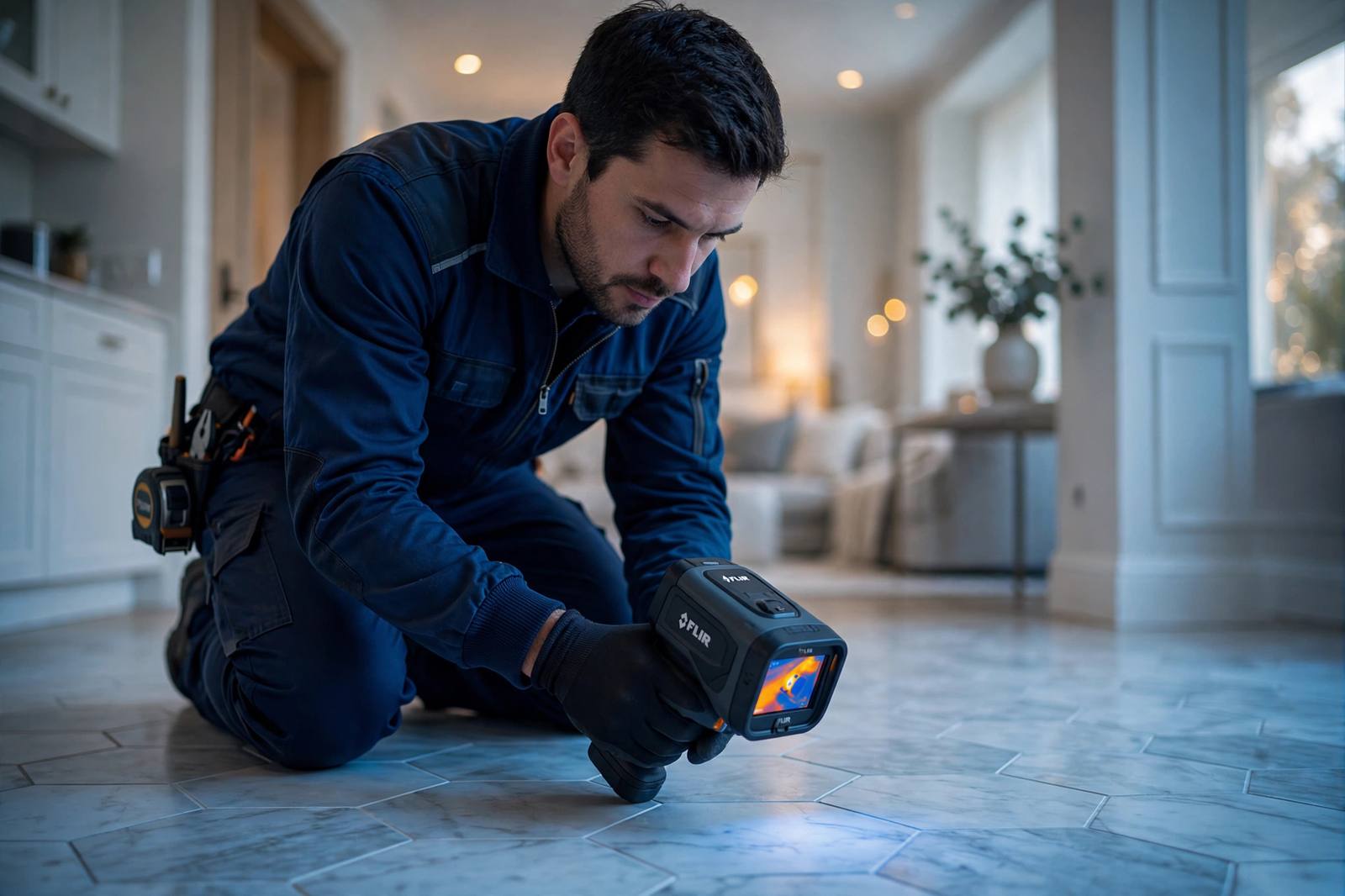
Detection starts with a conversation, not a jackhammer. Our New York City technicians begin by isolating your plumbing system: we shut off fixtures one by one, pressurize the hot and cold lines separately, and watch the gauges. If the hot line won't hold pressure, the leak is on the hot side — which immediately narrows the search. Next comes acoustic listening. We use ground microphones and electronic listening discs pressed to the slab to hear the hiss of pressurized water escaping — in a quiet house, an experienced tech can hear a pinhole leak through six inches of concrete. Thermal imaging cameras then scan the floor for the heat signature of a hot water leak, which shows up as a warm plume spreading from the break point; on cold lines we look for the cooling signature of evaporating water. For tricky cases we use line tracing — sending a signal through the copper itself to map exactly where the pipe runs under your floor — and video inspection of drain lines when a sewer-side leak is suspected. In Staten Island ranches with slab additions or in Queens split-levels with finished lower levels, we also check where the slab meets foundation walls, because leaks love to hide at cold joints. The whole process takes one to two hours, it's completely non-invasive, and you get a marked-up report showing the leak location within a few inches — no exploratory demolition, no guessing.
Slab Leak Repair Options in New York City
Once the leak is located, you have real choices, and the right one depends on your home's age, pipe condition, and flooring. A spot repair — opening a small section of slab directly over the leak and replacing that section of pipe — is the fastest and cheapest option for a single leak in an otherwise healthy system, and most New York City spot repairs are done in a day. Tunneling is the premium option: we hand-dig a tunnel beneath the slab from outside the foundation, repair or replace the pipe from underneath, and your flooring never gets touched. In Staten Island ranches with expensive tile or hardwood, tunneling often costs less in total once you factor in flooring replacement. A full reroute abandons the under-slab lines entirely and runs new PEX or copper through walls and ceilings — popular in Queens split-levels where attic and wall access is easy, and it eliminates future slab leaks permanently. A whole-house repipe is the nuclear option for homes with multiple leaks or 60-year-old copper throughout: higher upfront cost, but it ends the leak cycle for decades. For drain and sewer lines under the slab, trenchless lining and pipe bursting can replace failing cast iron without tearing up the house. We quote every viable option with honest total costs, including flooring restoration, so you can compare apples to apples instead of getting steered toward the one method a company happens to sell.
What Slab Leak Detection & Repair Costs in New York City
Detection in New York City runs $250 to $650 for a full diagnostic visit — higher than the national average because of labor costs, parking and access challenges, and the extra time co-op and condo scheduling sometimes requires. Most companies credit the detection fee toward the repair. Spot repairs typically run $3,000 to $5,500 all-in, including concrete and flooring restoration; New York City's higher labor rates and permit costs push this above Sun Belt prices. Tunneling usually lands between $4,500 and $8,000 depending on tunnel length and how many lines need work. A full reroute of the water supply lines runs $4,000 to $9,000+ in NYC homes, varying with home size, wall and ceiling access, and finish restoration. Whole-house repipes range from $8,000 to $20,000+ for larger homes. Three things drive New York City prices above average: labor rates among the highest in the country, Department of Buildings permits and inspections required for structural and plumbing work, and the simple reality that everything — parking a truck, staging equipment, hauling debris — takes longer here. Get the detection done first and get itemized quotes, because a $400 diagnosis frequently saves homeowners from a $3,000 exploratory demolition they didn't need.
What to Do When You Suspect a Slab Leak
If you suspect a slab leak, do four things in order. First, confirm it: turn off every faucet and water-using appliance, check your water meter, wait 30 minutes without using water, and check it again. If the meter moved, you have a leak somewhere. Second, find your main shutoff valve and make sure you can turn it — in a real emergency you need to stop the flow in seconds, and half of New York City homeowners we meet have never touched theirs. Third, shut off the water heater's cold supply if you suspect the hot line (warm floor spots point to the hot side), which limits damage while you wait for a pro. Fourth, call for detection before you call a demolition crew — the number one mistake we see is homeowners or handymen jackhammering floors on a hunch and finding nothing, turning a $4,000 repair into a $9,000 one. While you wait, move rugs and furniture off damp areas, run a dehumidifier if you have one, and take photos of everything for your insurance file. Don't ignore it for a month: in freeze-prone soil, a small leak becomes a foundation problem by spring, and insurance adjusters are far less generous with damage that sat unaddressed for weeks.
Get a Pinpoint Diagnosis in New York City
No jackhammer guesswork. Thermal imaging + acoustic equipment finds your leak within inches.
☎ Call (877) 762-1902New York City Slab Leak FAQs
How much does slab leak detection cost in New York City?
Most New York City homeowners pay $250 to $650 for a full detection visit using acoustic listening, thermal imaging, and pressure testing. The visit usually takes one to two hours and ends with a written report marking the leak's exact location. Many companies, including ours, credit the detection fee toward the repair if you move ahead with the fix.
Are slab leak inspections worth it in NYC?
Yes, they are worth doing on homes where the plumbing runs under concrete, especially post-war ranches in Staten Island and parts of Queens and Brooklyn. A $400 inspection that catches a small leak early can prevent $15,000 or more in foundation, flooring, and mold damage. Get one before buying an older home and after any winter freeze event.
Will homeowners insurance cover a slab leak in New York?
New York City policies usually cover the resulting water damage, such as ruined flooring and drywall, but not the pipe repair itself, which insurers classify as wear and tear. Sudden and accidental failures get better coverage than long-term seepage, so document when you first noticed symptoms and call quickly to strengthen any claim.
Which NYC neighborhoods get the most slab leaks?
We see the most failures in post-war Staten Island ranches in Annadale, New Springville, and Tottenville; in Queens split-levels and garden apartments in Bayside, Fresh Meadows, and Jackson Heights; and in Brooklyn bungalows in Mill Basin, Marine Park, and Gerritsen Beach. Any home built between 1945 and 1985 with original copper supply lines under concrete is in the prime risk window.
How long does slab leak repair take in New York City?
A straightforward spot repair is usually done in one day. Tunneling jobs take two to three days because of the hand excavation. A full reroute or repipe can take three to six days in NYC homes because of tighter working conditions and permit scheduling. DOB filings and inspections in some boroughs can add a few days of scheduling, which we coordinate for you.
Do you warranty slab leak repairs in New York City?
Yes. Spot repairs carry a multi-year workmanship warranty, and full repipes and reroutes come with extended warranties on both labor and materials. Everything is pressure-tested, and you get the warranty terms in writing before work begins.
Nearby Cities
Keep Learning
How Much Does Slab Leak Detection Cost in 2026?
Slab leak detection costs $150-$600 in 2026. Compare per-method pricing, what's included in a proper visit, cost factors, and how …
Slab Leak in New Construction: Is the Builder Responsible?
Slab leak in a new-construction home? Learn why it happens, what the 1-2-10 builder warranty covers, and how to make the builder p…
Slab Leak Repair Options: 4 Methods Compared
Slab leak repair options compared: spot repair, tunneling, reroute and repipe. Real costs ($500-$15,000), pros, cons, and how to c…